Forest Parameters
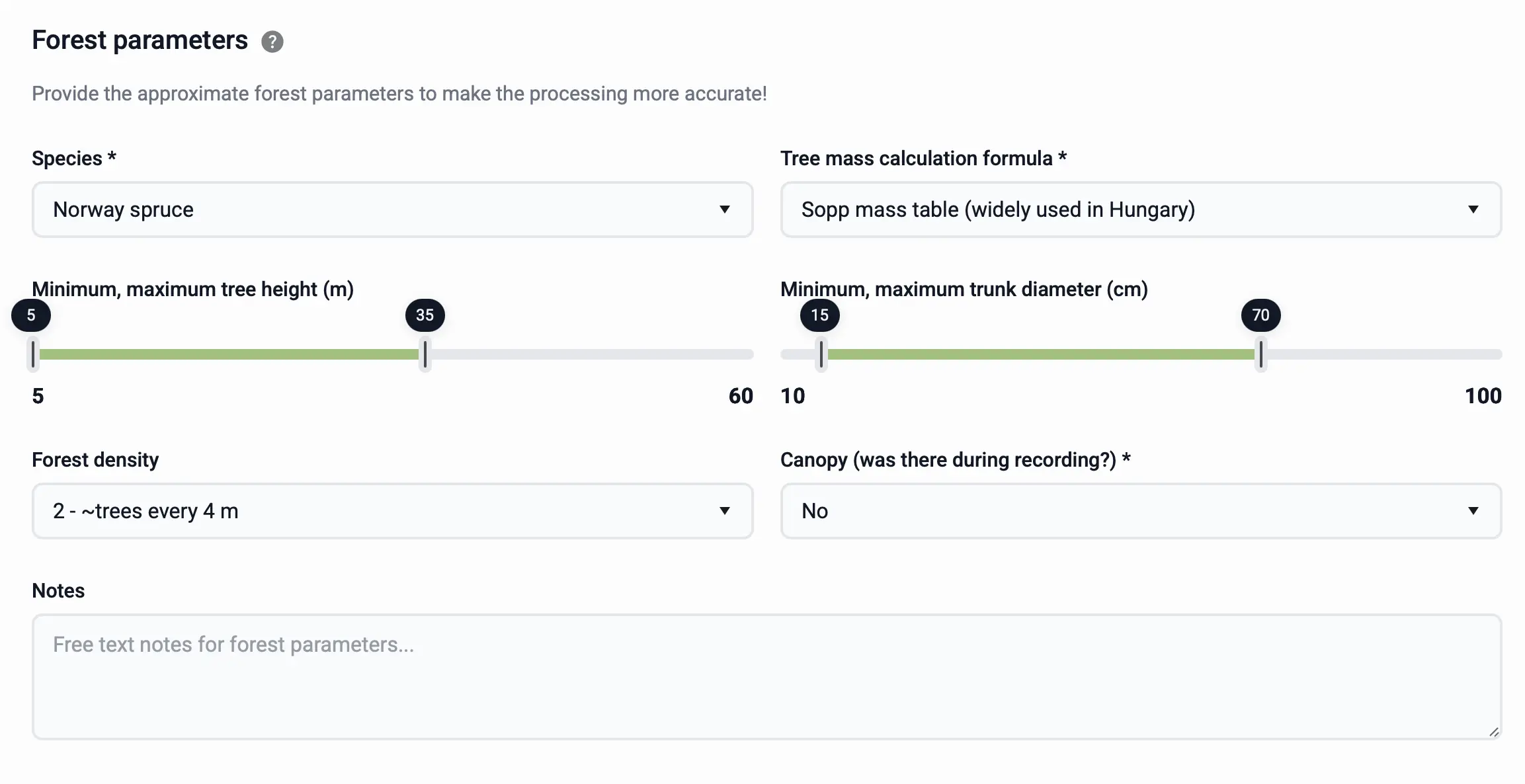
During upload, it is possible to enter parameters related to the forest stand.
These settings help refine calculations and produce species-specific metrics.
Available Parameters
- Tree species: selectable from a list (e.g., Beech, Black locust, Turkey oak, Pedunculate oak, Black pine, etc.).
Accurate species identification is important because volume calculations may differ by species.
⚠️ Warning! Enter the dominant species present in the area. If multiple species are present in the stand, indicate this in the notes field.
-
Timber volume calculation formula: multiple methods available:
, Sopp volume table (commonly used in Hungary) , Schumacher–Hall type equation , Form factor method (Formzahlmethode) , Allometric method , Sequential log fitting on point cloud , Height and diameter determination only -
Minimum and maximum tree height (m): defines the height range within which the system calculates tree heights.
-
Minimum and maximum trunk diameter (cm): specifies the trunk diameter range to be considered during processing.
-
Forest density: an estimated value, selectable by category:
- 1: trees approximately every 2 m
- 2: trees approximately every 4 m
- 3: trees approximately every 6 m
-
Canopy recording: indicate whether the survey was conducted in leaf-on conditions.
If yes, this may affect trunk measurements. -
Notes: a free-text field where additional information or supplementary data about the forest stand can be recorded.
⚠️ Warning! A complete tree inventory using photogrammetry can only be produced accurately in leaf-off conditions. In leaf-on conditions, the closed canopy may partially obscure trunks and the ground surface, meaning only tree counting is available when using photogrammetry.
✅ Advantage: By providing forest parameters, TreeDetect can calculate more accurate and species-specific metrics, so reports and analyses better reflect the actual stand characteristics.